iSiMAR
ANGLET
- Anglet Chairarchive photography
- Anglet Stool 79archive photography
Stackable
36 pieces across 16 collections carry the manufacturer’s own word for stacking — in the written specification, in the printed name, or photographed stacked in the maker’s archive. This page is the case for them; the same set answers the stackable filter in the catalogue.
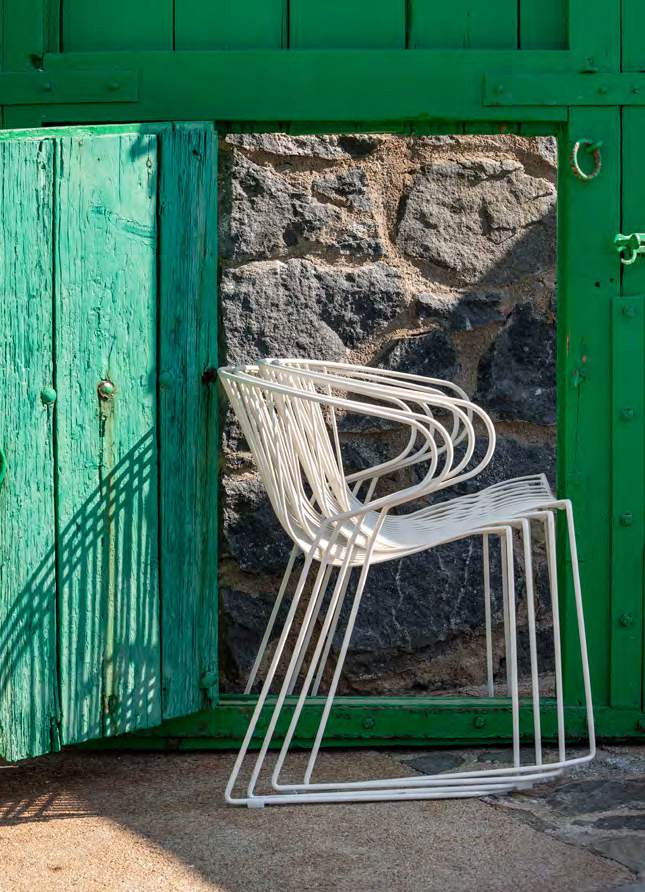
A commercial floor is not set once. It is turned — between a lunch sitting and a dinner service, between a conference and a wedding in the same function room, between the season a terrace earns and the months it stands closed. Every one of those turns is chairs moved by staff on the clock, and a chair that stacks moves as part of a column instead of as one more trip.
Weather forces the same arithmetic at short notice. An exposed terrace ahead of a southerly change has minutes, not hours, to come inside; a stacking run clears to the wall or the store room in columns, in one pass, and stands there without spreading. The alternative is furniture carried piece by piece while the front comes in — or left out in it.
And storage is the quiet cost. A store room is bought or leased in cubic metres, and furniture that cannot stack spends them one footprint per piece; a run of stacking chairs stores in the footprint of its column. For a venue that packs down seasonally, that difference is measured against every month the room is dark.
The pieces below are the ones our supplier files actually evidence for this. 28 carry it in the maker’s written specification, 9 are photographed stacked in the maker’s own archive, and one carries it in the printed product name. A piece that is not here is not evidenced either way — which is not the same as “does not stack”, and no line on this site renders the second from the first.
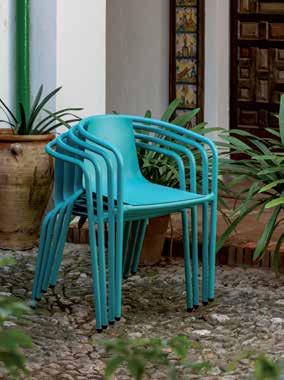
36 pieces, 16 collections, 2 houses. Under each piece: which of the maker’s records carries the evidence.
iSiMAR
iSiMAR
iSiMAR
iSiMAR
iSiMAR
iSiMAR
iSiMAR
iSiMAR
iSiMAR
iSiMAR
iSiMAR
iSiMAR
iSiMAR
iSiMAR
Kingsley Bate
Kingsley Bate
In 11 of these collections the maker evidences some seats and not their siblings — and we do not fill the gap by inference. MALLORCA’s chair is evidenced; its armchair, on the same frame in the same photograph, is not, and flagging it anyway would be writing a specification the manufacturer never published. TOPOS’s chair is evidenced; the same chair sold WITH its seat cushion is a configuration only iSiMAR can rate a stack for. So each range below names both columns, and the second reads “not evidenced” — never “does not stack”.
Stacking is one of three handling answers in the files. 24 pieces fold flat for storage or seasonal pack-away, and one nests once folded, so a row stores in one footprint. The Génova range’s folding and storage case is written up on the Varaschin page.
Every piece on this page is called stackable on the supplier’s own evidence — a written specification, a printed product name (“St. Tropez Stacking Chair”), or the supplier’s own photography of the piece stacked. Nothing here is inferred from shape, from siblings on a shared frame, or from our own eye — and where a supplier publishes no stacking quantity, none is invented.