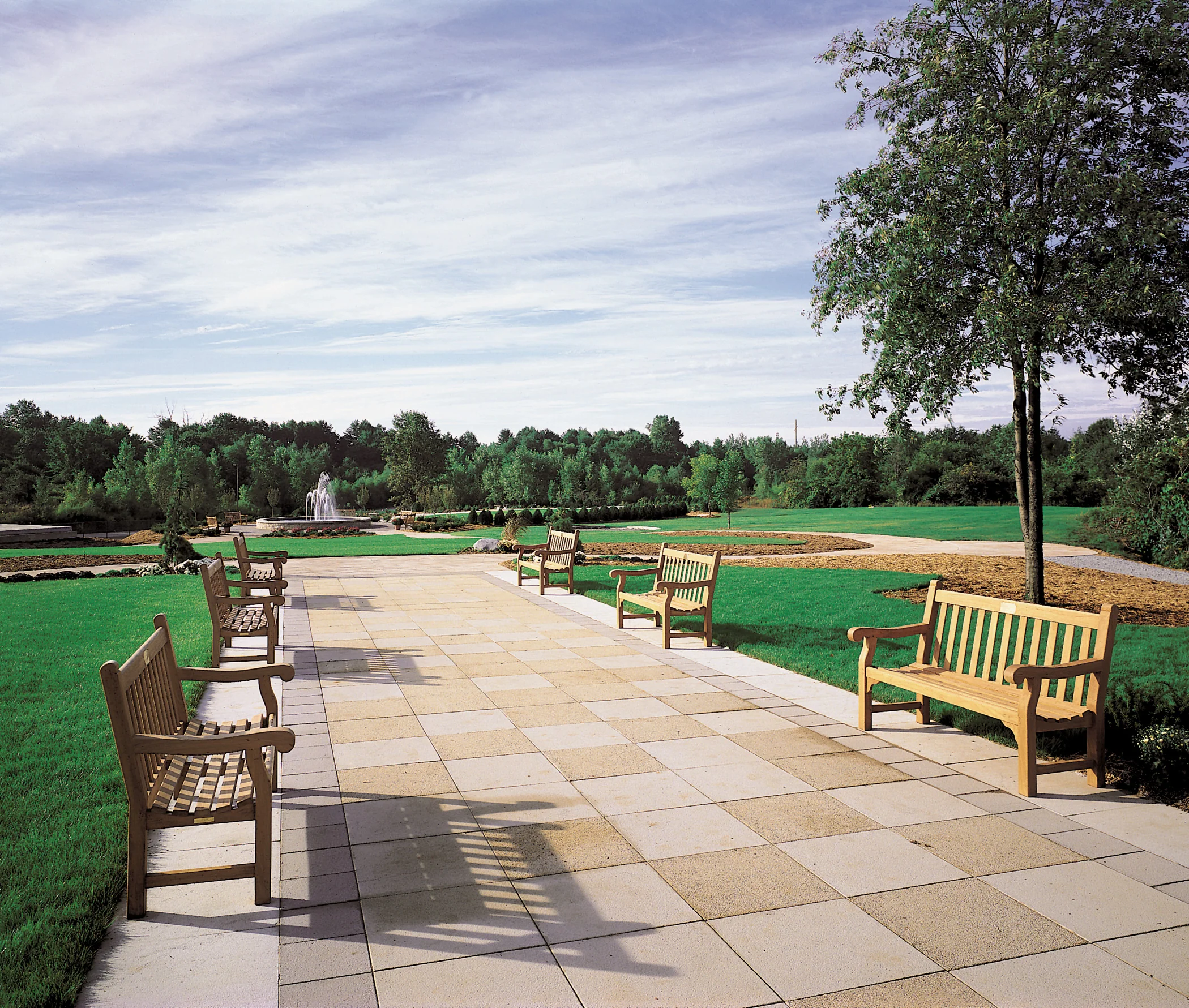
What outdoor furniture is best for a golf club terrace?
For a terrace that is exposed and expected to last a full committee cycle, teak with stainless fixings is the default, because it is the only common outdoor material that can be restored rather than replaced when it looks tired. Powder-coated marine-grade aluminium is the better answer where pieces must be light enough for staff to move daily, and all-weather woven where the brief wants lounge comfort. The mistake to avoid is specifying for how the terrace looks on handover rather than how it can be brought back in year seven.
Does teak furniture survive salt air on a coastal course?
Yes — teak is one of the few timbers whose natural oil content lets it sit in salt air untreated, and it is standard specification on bayside and links courses for that reason. The parts that fail in salt are the metal ones, so the fixings matter more than the timber: stainless holds, and plated mild steel does not. Left unoiled, teak silvers to grey; that is a surface change, not decay, and it can be brought back.
How do we stop the terrace looking tired after five or six years?
Budget for soft goods separately from frames. On a correctly specified terrace, the frames are still structurally sound long after the cushions have gone flat and faded, so re-covering on a planned cycle keeps the whole terrace current for a fraction of a replacement. Teak can be cleaned and re-oiled on the same cycle. Both are handled through the Custom & Contract desk.
What should we specify for a terrace that clears for events?
Filter for stacking first, before aesthetics — it removes most of the catalogue and prevents specifying a range that then has nowhere to go. Then check the weight of a single piece against the reality that staff, not installers, will be moving it, and check that stacked pieces do not mark each other, because that is what turns a two-year-old chair into a shabby one.
How do we choose umbrellas for an exposed clubhouse terrace?
Compare published wind ratings rather than descriptions. Cantilever umbrellas give the clearest terrace but carry the highest loads and need the heaviest bases or a fixed mount; centre-pole is more tolerant but takes floor space out of the layout. On a terrace with no adjacent building to break the wind, specify the shade at the start of the project against a rating, not at the end against what is left in the budget.
Can we match existing furniture when a few pieces get damaged?
That depends entirely on whether the range is still in production, which is why range longevity is worth weighing at specification time on a purchase this long-lived. Established teak houses keep collections in production for many years, which is what makes a partial replacement possible instead of a full re-buy. Ask the trade desk to confirm the current status of a specific collection before committing a large schedule to it.
How should a clubhouse be zoned for furniture?
Treat it as four briefs, not one. The members’ terrace is a comfort and appearance specification; the event lawn is a stacking and storage one; the halfway house is pure exposure with no shelter and the highest turnover per seat on the property; and the balcony or verandah is usually the tightest footprint with the best view to protect. They share a timber and a colourway so the property reads as one place, and almost nothing else. Specifying them as a single schedule is what keeps the first true and stops the other three being compromises.
Do you supply golf clubs directly, or through a dealer?
Commercial and club work goes through the Custom & Contract desk, which handles specification, volume and made-to-order work directly. File a brief with the venue, the covers and the month it is needed and the conversation starts at material and schedule rather than at introductions.